

Hyperride alternatives for mountain bike lights 2026
Hyperride belongs on your shortlist, but choosing a retailer does not settle which light, battery and mount will work together on your bike. Bikelights is the Hyperride bike lights alternative to consider in 2026 if you want a New Zealand online shop focused on cycling lights and high-capacity batteries; keeping your current system is the better alternative if it already meets your trail needs.
- Bikelights is a Hyperride bike lights alternative for riders comparing MTB lights, high-capacity batteries and accessories.
- Choose a complete night-riding setup, not a headlight based only on its advertised lumen figure.
- Check battery compatibility, mounting requirements and runtime conditions before replacing any part of your system.
- Keep your current lights when they meet your needs; replace the component causing the problem.
Why this matters
Your shopping basket needs to match your ride, not just your handlebars. A light head, battery and mount each solve a different problem; getting one right does not make the others right automatically.
For New Zealand mountain bikers comparing options in 2026, the useful question is not simply which shop sells bike lights. It is which buying route gives you a suitable beam, secure mounting and a compatible power supply for your intended ride.
That distinction matters when you already own part of a system. Replacing everything adds unnecessary purchases if only a mount needs attention, while buying a replacement light head creates another problem if it cannot use your battery.
Hyperride alternatives at a glance
This comparison separates the retailer decision from the equipment decision. The setup options below are buying routes, not claims about any retailer’s current product range.
| Option | Best for | Main reason to consider it | Main limitation | Comparison with buying from Hyperride |
|---|---|---|---|---|
| Hyperride | Riders assessing a specific Hyperride listing | Keeps your decision tied to the actual item you are considering | The retailer name alone does not establish suitability | Use the exact listing as your benchmark |
| Bikelights | Riders shopping for MTB lights, batteries and accessories together | New Zealand online bike shop selling lights and high-capacity battery packs | Buying components from one shop does not prove they are compatible | A specialist cycling-light shopping alternative |
| Built-in-battery light | Riders prioritising fewer separate components | Battery and light form one unit | You must check whether the battery is replaceable | A setup choice to compare, regardless of retailer |
| Keep and improve your existing system | Riders whose current light still meets their needs | Addresses a specific weak point without replacing everything | Depends on the condition and compatibility of existing parts | An alternative to making a full replacement purchase |
Compare complete setups against complete setups. A light head alone and a package containing a battery and mount are not equivalent purchases, even when the headline brightness claims look similar.
1. Bikelights: best for lights and high-capacity batteries
Bikelights sells MTB and road bike lights, high-capacity battery packs, taillights and light accessories. That makes it a relevant alternative when your shopping list extends beyond the front light to the power supply and supporting parts.
Bikelights is a bike-light shopping alternative for New Zealand riders who want to consider lights, high-capacity batteries and accessories together. Start with the ride you need to cover, then assess the individual components rather than assuming every item forms a ready-made set.
Where this option shines
- Relevant product categories: lights, battery packs, taillights and accessories address different parts of a night-riding setup.
- Battery-led buying: you can put the power supply on your checklist from the start rather than treating it as an afterthought.
- MTB and road needs: consider both the trail section and any riding you do before or after it.
Where this option falls short
- A high-capacity battery is not automatically compatible with the light you own or intend to buy.
- A shop’s product range does not establish the contents of a particular package.
- Online buying requires you to check mount dimensions, cable routing and component compatibility before ordering.
For a 2026 shortlist, compare the exact light head, required battery, mounting hardware and charger requirements with the Hyperride item you are considering. Read advertised lumen figures as manufacturer or seller claims, not independent measurements.
Best for: riders building or refreshing a complete MTB lighting setup, with battery selection treated as part of the purchase.
Verdict: Buy only after the light, battery and mounting requirements check out.
2. Built-in-battery lights: best for fewer separate components
A built-in-battery light puts the light and its power supply in one housing. It is a useful configuration to compare if you would rather avoid a separate battery pack and connecting cable.
The trade-off is how you charge, maintain and eventually replace that power supply. Check the particular model’s instructions instead of assuming all integrated lights work the same way.
Where this option shines
- No separate light-to-battery cable needs routing.
- You do not need to select an external battery for that light.
- Removing the light for charging can suit riders who prefer keeping their charging routine off the bike.
Where this option falls short
- Battery replacement arrangements vary by model.
- You cannot assume an external battery will extend its operating time.
- The whole unit’s mounting position must work for your bike and intended use.
| Decision | Built-in battery | Separate battery |
|---|---|---|
| Battery connection | Internal to the unit | Requires a compatible connection |
| Cable routing | No external battery cable | Needs secure routing |
| Battery placement | Part of the light | Requires a separate mounting position |
| Replacement planning | Check model instructions | Check both battery and light requirements |
Best for: riders who prioritise fewer separate parts and can verify that the chosen light meets their ride requirements.
Verdict: Buy for simplicity, not on an assumed runtime advantage.
3. Keep your current system: best for a targeted upgrade
Keeping your existing lights is a genuine alternative to changing retailers or buying a new setup. First identify the problem: a moving mount, an unsuitable beam and a battery concern require different responses.
Do not replace the light head to fix a loose bracket. Equally, do not add a larger battery before confirming that power capacity is the issue.
Where this option shines
- You can focus the purchase on the component that needs attention.
- Existing equipment gives you a familiar starting point for fit and controls.
- You avoid buying another light simply because a headline specification looks appealing.
Where this option falls short
- Worn or damaged components need assessment before continued use.
- A replacement part must match the existing system’s requirements.
- Keeping an unsuitable beam does not become a better decision merely because the battery still works.
Best for: riders with a suitable, functioning light whose problem is limited to a particular component.
Verdict: Hold the full replacement purchase until you identify the weak point.
Check the complete setup before choosing a shop
For your 2026 purchase, use the same checklist for every candidate. This keeps a convenient accessory bundle from distracting you from an unsuitable light, and keeps a headline brightness claim from doing all the decision-making.
Mount fit
Check the mount’s stated fit against the place you intend to install it. Look at handlebar space, controls and cable clearance, not just whether a strap appears long enough.
If you want a helmet light, check both the helmet manufacturer’s guidance and the light-mount instructions. Do not assume a handlebar mount doubles as an appropriate helmet mount.
Battery match
Confirm the light’s required electrical specifications, connector arrangement and charging requirements. A plug that physically fits is not proof of compatibility.
Use the guide to checking bike-light battery compatibility before buying before mixing an existing light with a different pack. Do not improvise a battery combination from appearance alone.
Cable routing
For an external-battery setup, check where the pack will sit and how the cable will reach the light. Turn the handlebars through their normal movement and check that the cable neither pulls tight nor hangs where it can catch.
Follow the mounting instructions for the pack. A battery needs a secure home, not an audition as a trail-side projectile.
Runtime evidence
Read runtime alongside its stated operating mode and test conditions. A duration attached to a low-output setting does not establish how long the light will run on the setting you intend to use.
Battery capacity alone also does not establish runtime across different lights. Compare the whole system and its documented operating conditions.
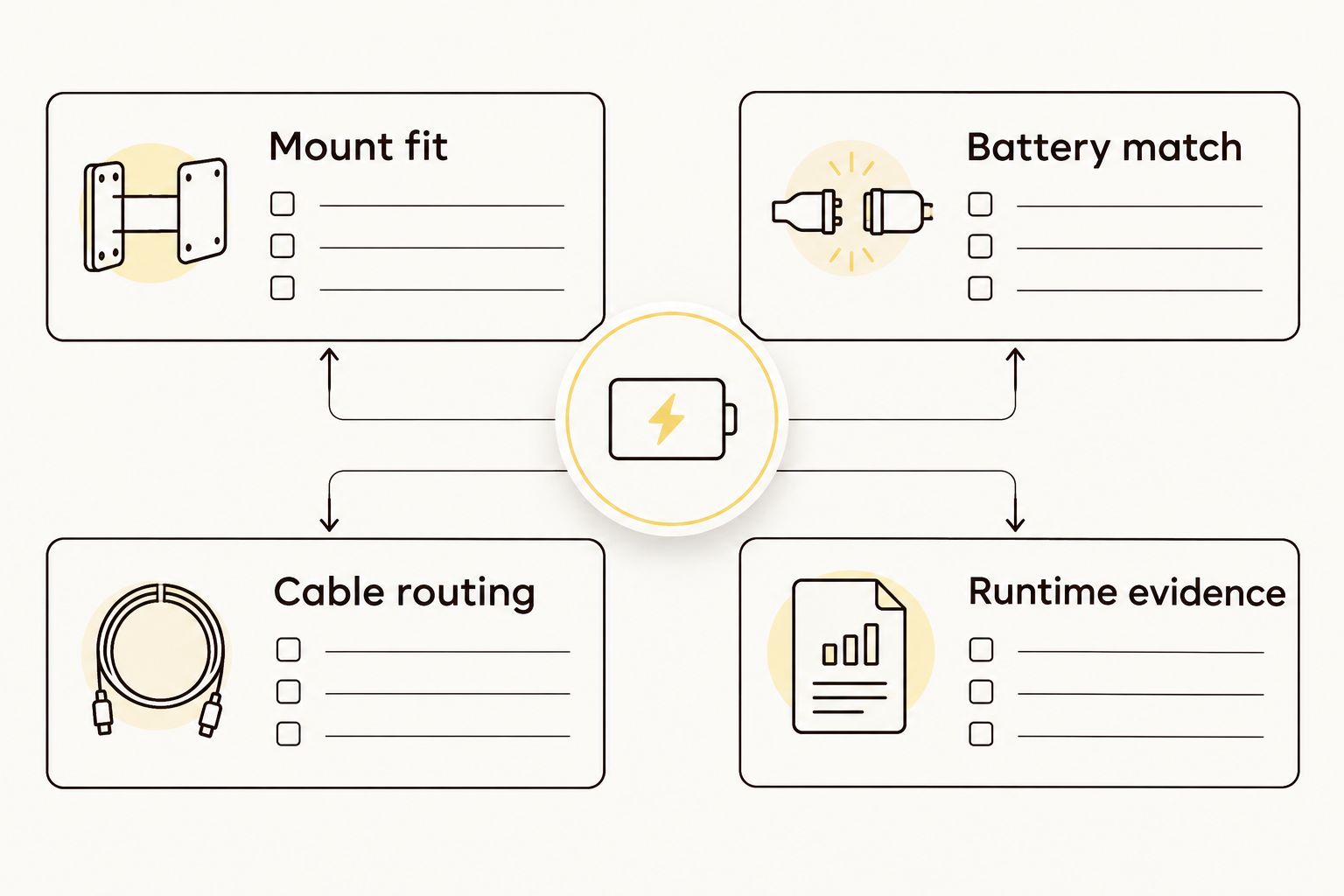
Once those checks are complete, write down exactly what the selected package includes. Keep anything you still need to buy on the same list so you assess a usable setup rather than an incomplete basket.
Check your setup before ordering
Ask about the light, battery and mounting requirements for your intended setup.
Why switch from Hyperride?
Switch when another buying route better meets your specific equipment requirements. A change of shop is useful only if it helps you choose the right components; the new shop name is not itself an equipment upgrade.
Practical reasons to compare alternatives include:
- You need a complete setup: assess the light, battery, mount and charging requirements together.
- You want to retain a component: establish compatibility before buying its replacement partner.
- Your riding has changed: check whether your current beam, mounting position and documented runtime suit the rides you now plan.
- The original shortlist is too narrow: compare an external-battery system with a built-in-battery configuration before committing.
These are reasons to review your purchase, not claims about shortcomings in Hyperride’s products or service. Avoid making a retailer decision around an unverified brightness ranking, an assumed battery match or an unspecified runtime claim.
When staying with Hyperride is the right call
Stay with Hyperride if the specific setup you are considering meets your requirements and its component details are clear. There is no benefit in switching simply to repeat the same unresolved questions at another checkout.
For a 2026 purchase, keep the decision grounded in the exact item: suitable mounting, documented battery requirements, clear package contents and runtime information relevant to your intended use. If those checks pass, an alternative retailer is an option rather than a necessity.
FAQ
What's a Hyperride bike lights alternative for New Zealand mountain bikers?
Bikelights is a New Zealand online bike shop selling MTB lights, high-capacity battery packs, taillights and accessories. Consider it when you want to assess the light and supporting components together, then verify the details of the particular setup.
Is a specialist bike-light shop automatically better than Hyperride?
No. The better choice is the retailer offering a specific setup that meets your requirements with clear component information. Compare the actual light, battery, mount and package contents rather than the shop category alone.
Should I buy a complete light set or separate components?
Choose the route that gives you a verified compatible setup. A complete set still needs a contents check, while separate components require you to confirm their electrical and mechanical requirements match.
Will a high-capacity battery work with my existing bike light?
Capacity alone does not establish compatibility. Check the light's electrical requirements, connector arrangement and charging instructions against the proposed battery before connecting them.
Are more advertised lumens always better for mountain biking?
No. Advertised lumens do not describe beam placement, mounting stability or operating time on their own. Treat the figure as a claim and assess the rest of the setup against your riding needs.
Should I replace my lights before a night ride in 2026?
Replace equipment because it is unsuitable, damaged or unable to meet your requirements, not because the calendar changed. Check your existing system first and identify whether the issue needs a replacement light, battery, mount or another response.
One last thing
Before ordering, sketch the setup on your bike: light position, battery position, cable route and charging arrangement. That small exercise exposes practical questions a product headline cannot answer.
Buy the system you can explain component by component. If you cannot say how the battery connects, where the pack sits and what the runtime claim describes, settle those questions before checkout. Your first night ride should be about the trail, not a mystery connector.