

Cycle Science alternatives for bike lights 2026
A Cycle Science light setup is worth keeping when its beam, mounts and battery already suit your night rides. The ceiling comes when that setup no longer covers the ride you want to do. The best Cycle Science bike lights alternative in 2026 is Bikelights if you want to shop for MTB lights and high-capacity battery packs together; an integrated-battery light is the alternative to consider if you prefer fewer separate parts.
- Bikelights is a Cycle Science bike lights alternative for riders shopping for MTB lights and high-capacity battery packs.
- Choose a complete night-riding setup around beam, mounting security and verified battery compatibility, not advertised lumens alone.
- Integrated-battery lights reduce separate components; external-battery setups add a pack and cable to secure.
- Keep your existing Cycle Science setup when it already meets your trail, mounting and runtime needs.
Why this matters
Shopping for night-riding lights is really shopping for a working system. The light needs to show the trail, the mount needs to hold its aim, and the battery needs to support the setting you intend to use.
A headline brightness claim answers none of those questions by itself. Neither does a large battery-capacity figure without the voltage, compatibility and operating conditions beside it. Your handlebars are not a trophy shelf for impressive numbers.
For your 2026 shortlist, compare complete setups rather than shop names alone. A different retailer only solves the problem when the actual light, battery and mounting arrangement suit your ride better.
Cycle Science alternatives at a glance
This comparison separates the retailer decision from the hardware decision. The alternatives below are shopping routes, not claims that every light sold through a particular retailer has the same features.
| Option | Best for | Main distinction | What to check against your Cycle Science setup |
|---|---|---|---|
| Cycle Science setup | Riders whose existing lights already meet their needs | Keeps the equipment you know | Whether beam, mount and battery still cover your intended ride |
| Bikelights | Shopping for MTB lights and high-capacity battery packs together | Sells bike lights, battery packs, taillights and accessories | Exact light-and-battery compatibility, mounting requirements and included parts |
| Integrated-battery light | Riders who want fewer separate components | Battery sits within the light unit | Required runtime, charging access and mounting fit |
| Replacement light head with an existing compatible pack | Riders replacing one part of an external-battery system | Retains the pack rather than replacing the whole setup | Manufacturer-confirmed electrical and connector compatibility |
Best for means the option matches that particular buying brief. It does not mean every model within the category suits technical trails, wet rides or long outings.
1. Bikelights: best for lights and battery packs together
Bikelights is a New Zealand-based online bike shop selling MTB and road bike lights, high-capacity battery packs, taillights and light accessories. That product focus makes it a relevant starting point when you want to consider the light and its power supply in the same buying decision.
Start with your actual ride rather than the biggest advertised output. Decide where the light will sit, how the battery will be secured and which operating mode needs to last through your route.
Where Bikelights shines
- Relevant product categories: bike lights, high-capacity battery packs, taillights and accessories are all part of the stated range.
- A complete-setup buying brief: you can assess the light, power supply and mounting needs together instead of treating the battery as an afterthought.
- MTB relevance: mountain-bike lights are explicitly part of the shop's offering.
Where Bikelights falls short
- Online fit assessment takes homework: you need to compare your handlebar, frame and intended mounting position with the chosen equipment's requirements.
- Separate packs add setup work: an external-battery arrangement needs a secure pack position and sensible cable routing.
- Category coverage is not compatibility: a shop selling both lights and batteries does not establish that any particular pair works together.
Head-to-head: the buying decision
| Dimension | Bikelights route | Keep your Cycle Science setup |
|---|---|---|
| Starting point | Select lights and battery packs around a new ride brief | Assess the equipment already fitted |
| Compatibility task | Confirm the chosen combination before ordering | Recheck compatibility before changing any component |
| Mounting task | Check all proposed mounting positions | Inspect existing mounts and correct movement |
| Decision trigger | Your current setup leaves a specific requirement unmet | Your current setup continues to meet the requirement |
Best for: New Zealand mountain bikers shopping for lights and high-capacity battery packs as a complete night-riding setup.
Verdict: Buy only after the exact light, battery and mounting arrangement checks out.
2. Integrated-battery lights: best for fewer separate parts
An integrated-battery light houses its battery within the light unit. It removes the separate battery-pack connection from that light's setup, although the mount and charging arrangements still need attention.
That simplicity is useful when you dislike routing cables or finding a secure place for a separate pack. It does not establish that a particular model has enough beam coverage or runtime for your trails.
Where integrated-battery lights shine
- Fewer separate components to attach before a ride.
- No external battery cable between that light and a frame-mounted pack.
- A straightforward configuration to assess if your main complaint is setup fuss.
Where integrated-battery lights fall short
- You cannot assume the internal battery is user-replaceable.
- Charging arrangements depend on the specific light.
- A tidy installation does not compensate for an unsuitable beam or insufficient verified runtime.
| Dimension | Integrated-battery option | Your Cycle Science baseline |
|---|---|---|
| Battery location | Inside the light unit | Identify the arrangement on your current light |
| Separate pack mounting | Not needed for that light | Check whether your existing setup requires it |
| Replacement flexibility | Depends on the model's battery design | Check the existing product's instructions |
Best for: riders whose priority is reducing separate parts, provided the chosen light meets their trail requirements.
Verdict: Buy for simplicity, not on the assumption that integrated means trail-ready.
3. A replacement light head: best for keeping a compatible pack
Replacing only the light head is another route when you already own an external battery. The existing pack must be suitable for the replacement head; a connector that plugs in is not proof of electrical compatibility.
This is a component-level alternative rather than a reason to change retailers. Read the battery compatibility buying guide before matching a replacement head to an existing pack.
Where a replacement head shines
- Keeps a usable, confirmed-compatible pack in service.
- Targets the component you actually need to change.
- Avoids replacing functioning equipment merely to obtain a different light head.
Where a replacement head falls short
- Compatibility needs confirmation beyond connector appearance.
- An ageing or damaged pack remains a problem after the head changes.
- Mounts, cables or chargers can introduce additional compatibility checks.
Best for: riders with a serviceable external pack and explicit confirmation that it supports the replacement head.
Verdict: Hold until compatibility is confirmed; skip the mix-and-match guesswork.
How to compare a complete trail-light setup
For a useful 2026 comparison, give each shortlisted setup the same job. Write down the route, intended light position and operating setting before reading product claims.
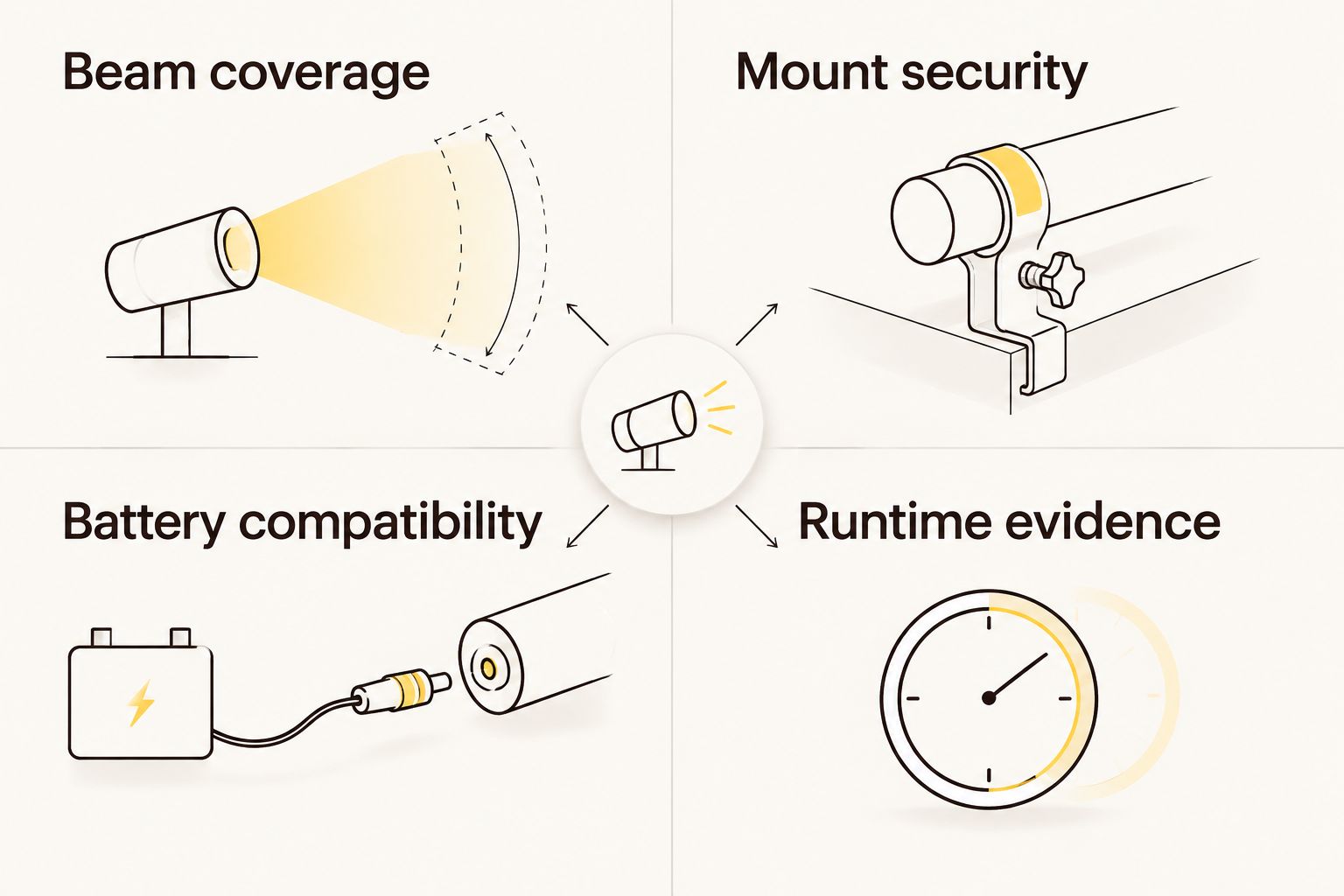
Beam coverage
Look for evidence of how the beam illuminates the trail, not just its advertised lumen figure. A bright central spot and a broader beam distribute light differently; the useful choice depends on where you need to see.
Treat advertised lumens as manufacturer claims unless independent testing is identified. A higher claim alone does not prove better visibility through corners or over nearby roots.
Mount security
Check the required mounting diameter or interface against your bike. Think about the space already occupied by brake hoses, controls and other accessories.
A mount that moves changes where the beam points. Correct fit matters before you start debating which light has the more impressive specification sheet.
Battery compatibility
For an external pack, confirm voltage, connector specification, polarity and the manufacturer's compatibility guidance. Do not connect equipment simply because the plug looks familiar.
Capacity comparisons also need care. Milliamp-hours describe charge capacity; watt-hours account for voltage as well, so mAh figures alone are not a fair comparison between packs operating at different voltages.
Runtime evidence
Match the runtime claim to its named operating mode and stated conditions. Check whether the documentation describes output changes during the run rather than assuming full brightness lasts until the light switches off.
For example, a planned 2-hour ride is your requirement, not evidence that a particular battery will provide 2 hours at your chosen setting. Allow for your ride home and delays without inventing a universal reserve figure.
A high-capacity pack is useful only as part of a suitable system. Check the light connection, pack position and charging requirements together; otherwise you have bought a bigger component, not solved the ride.
Build your night-riding setup
Compare bike lights and battery packs, then confirm compatibility and mounting requirements.
Why people switch from Cycle Science
A sensible switch starts with a specific unmet need, not an assumption that another shop must be better. Use these as decision criteria, not claims about Cycle Science products or service.
- Your ride has changed: the equipment that worked for your previous route no longer meets the new ride's requirements.
- You need to replace a component: a light, mount or battery needs attention, and you want to compare replacement routes.
- You want a different configuration: fewer separate components or a compatible external-pack arrangement better matches how you ride.
- You are buying a complete setup: you want to assess lights, mounts and power together rather than assemble the system by guesswork.
For a 2026 purchase, write the problem in one sentence before choosing the alternative. If the problem is a loose mount, replacing an otherwise suitable light system is not the first fix.
When staying with Cycle Science is the right call
Keep your existing Cycle Science setup when it provides the beam coverage, secure fit and verified runtime your rides require. A new retailer name does not improve equipment that already does the job.
Check the condition of the light, mounts, cables and battery first. Follow the manufacturer's instructions for inspection and care, and resolve damage or uncertain compatibility before riding.
The useful comparison is your working setup against a documented replacement. Not your familiar light against a collection of bigger advertising numbers.
FAQ
What's the best Cycle Science bike lights alternative for MTB riding?
Bikelights is a relevant alternative for riders shopping for MTB lights and high-capacity battery packs together. Choose the specific setup only after checking beam coverage, mounting fit, battery compatibility and documented runtime.
Should I replace my Cycle Science lights if they still work?
Keep your Cycle Science lights if they remain suitable for your route and are in sound condition. Replace or change equipment to solve a specific problem, not simply to change shops.
Is an external battery better than a built-in battery for night riding?
Neither configuration is automatically better for night riding. An external battery adds a separate pack and connection to manage, while an integrated light keeps the battery inside the unit; the chosen model still needs suitable beam coverage and runtime.
Can I use my existing battery with a different bike light?
Use an existing battery with a different light only when compatibility is confirmed. Check voltage, connector specification, polarity and the manufacturer's guidance rather than relying on plug shape.
Does a higher lumen claim mean a better mountain-bike light?
A higher advertised lumen figure does not by itself establish a better mountain-bike light. Beam distribution, mounting stability and output over the ride also affect whether the setup suits your trail.
How do I know whether a battery will last my night ride?
Compare your planned ride with the documented runtime for the operating mode you intend to use. Check the stated conditions and output behaviour, and include the journey home and possible delays in your planning.
What should I check before buying bike lights in 2026?
Check the complete system: light, mount, compatible power supply and charging requirements. Confirm what is included rather than assuming the pictured setup contains every part you need.
One last thing
Before your first trail outing with a changed setup, check it somewhere familiar. Turn the handlebars fully, check cable slack, confirm the pack stays secure and make sure you can operate the light without hunting for its controls.
Then check the beam aim again. The best 2026 upgrade is the one that fixes your actual riding problem, not the one that wins a screenshot contest.